Professor Bikramjit Basu is currently serving as the Director of the Council of Scientific and Industrial Research-Central Glass & Ceramic Research Institute (CSIR-CGCRI), Kolkata (on deputation from Indian Institute of Science, Bangalore), since November, 2024. At CSIR-CGCRI, he has been providing scientific leadership in various nationally-important mission-oriented research programs that seamlessly integrate fundamental science and applied technologies with industry translation, critical to India’s journey to become self-reliant. At CSIR-CGCRI, he mentors and oversees large interdisciplinary research programs of more than 300 full-time employees, including around 90 scientists. (Link: Director | CSIR-Central Glass & Ceramic Research Institute).
We welcome you to watch the video, Professor Bikramjit Basu: Inspiration for the Next Generation
A documentary on Prof. Bikramjit Basu’s research group
Research Summary
Initiated originally at the Indian Institute of Technology, Kanpur (2001–2011), and expanded at the Indian Institute of Science, Bangalore (2011-present), our multidisciplinary research laboratory works at the confluence of materials science, engineering design and manufacturing, biological sciences, and medicine. Through this integrated approach, our research group has delivered foundational scientific insights alongside translatable technologies that address real-world challenges in human health and strategic sectors. In the area of Ceramics, his independent research program is focused on combining experimental and computational analysis to develop a spectrum of oxide/non-oxide ceramics for tribological, aerospace and, renewable energy -related applications.
Advancing healthcare technologies through Biomaterials and Medical Devices Innovation
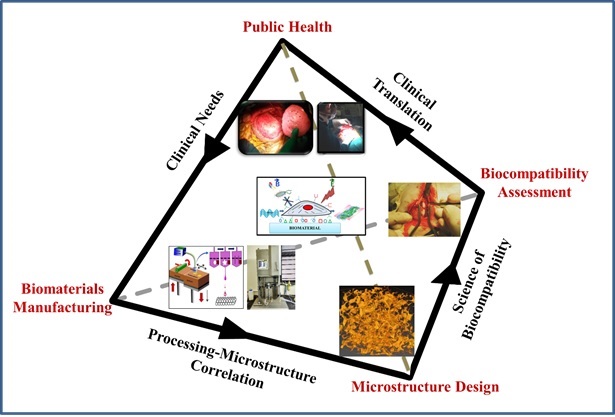
A defining hallmark of our group has been the sustained focus on biomaterials innovation for healthcare applications, since 2006. Prof. Basu’s laboratory has been pursuing interdisciplinary translational research at the challenging crossroads of Materials Science, Design and Manufacturing, Biological Science, and Medicine. His team uses the principles and tools of these disciplines to develop next-generation biomaterials, implants, and bioengineering solutions to address clinical needs for musculoskeletal, dental, neurosurgical, and urological applications, thereby impacting public healthcare. Prof. Basu’s laboratory continues to explore the science of biocompatibility and bioengineering strategies, utilizing biomechanically compliant implant design, and multifunctional hydrogel for additive manufacturing, as well as innovative biomaterials and biophysical simulations for regenerative bioelectronic medicine. In particular, his research provides a greater insight into how stem cells can sense electrical stimuli in a substrate conductivity-dependent manner and change the functionality (acquiring a specialized function) to bone-like, neuron-like, glial-like, or cardiac-like cells. In rationalizing the experimental results, his research group proposed bioelectric stress-mediated mechanotransduction as the biophysical pathway and probed biomolecular interactions using atomistic simulations, Molecular Dynamics (MD)’. In the field of additive manufacturing, Prof. Basu’s group has developed a quantitative understanding of the process science for laser-powder based fusion, Binderjet 3D printing of lattice-structured metallic implants as well as extrusion 3D printing and digital light processing (DLP) of soft hydrogels with shape fidelity compliance. His research group also established the capability of tree-based regression and classification algorithms to develop better predictive capabilities for additive-manufactured metallic implants.
Societal relevance and Strategic Self-Reliance through Innovations in Advanced Materials
India, having the highest elderly population by 2025, has thus acquired the label of “an ageing nation” with 7.7% of its population being more than 60 years. While the overall population of India will grow by 40% between 2006 and 2050, the population of those aged 60 and above will increase by 270%. The life expectancy of an average Indian has seen significant enhancement from 28 (in 1947) to 71 (in 2025) and is expected to reach 85 by 2047. The increase in life expectancy has a direct and amplifying effect on many of the aging related diseases, which demand the indigenous technologies for orthopedic (hip/knee surgeries) and dental implants (edentulism- toothlessness) to cater to the needs for the citizens of India across the social crosse-sections. In India, more than 80% such implants are still imported and make them highly unaffordable to a larger cross-section of the people. Apart from the public healthcare demanding the availability of such medical devices in different sizes, the patient-specific implants are often needed to treat many patients.
The societal relevance of Prof. Basu’s research is evidenced by successful translation of multiple technologies into manufacturing and clinical practices. In this context, our research group developed technologies involving the implantable biomaterials, conventional and additive manufacturing and quantitative biocompatibility assessment, for orthopedic, dental and craniomaxillofacial reconstructive surgeries. His group’s work has led to the commercialization of calcium phosphate bioceramic, injection-molded UHMWPE implants, Ti6Al4V-based metallic implants for dental restoration, and patient-specific bone flaps for cranioplasty surgery. Many of these technologies are either co-developed or transferred to the MNCs or start ups and used for patient care in India. In collaboration with over 25 clinicians, the clinical performance of dental and cranioplasty implants has been successfully validated in three different hospitals in India on more than 85 patients. As the outcome of our translational research, more than 35 clinicians, including 15 prosthodontics from 10 different hospitals in India were trained in adapting the indigenous technologies of medical devices for patient care. These indigenous implants will help advancement of affordable, yet high quality implantology in India.
Beyond healthcare, Prof. Basu has made sustained contributions to India’s strategic self-reliance and technology ecosystem through engagement with national agencies including the DAE, BARC, DRDO, and the ISRO. His expertise in advanced ceramics, and manufacturing technologies has supported strategic materials development aligned with national priorities in defence, space, and critical infrastructure. In the area of Engineering Ceramics, his research group has established processing–microstructure-property correlations in transformation-toughened zirconia, in-situ toughened silicon nitrides, and ultra-high temperature ceramics (transition metal borides) for tribological, space, and energy-related applications.
Professor Bikramjit Basu is serving as Director, Council of Scientific and Industrial Research-CGCRI, Kolkata, India since November 2024.
At CSIR-CGCRI, he has been serving Scientific mentoring/ national-level leadership of more than 14 million Euros projects with industries and SMEs in strategic area and healthcare sector and key administrator for 320 Full-Time Employees (FTEs; 91 Scientists), who pursue science-driven technology development in India.
Over last two decades, Professor Bikramjit Basu established vibrant research programs at Indian Institute of Technology, Kanpur (2001-2011) and Indian Institute of Science, Bangalore (2011-present). He has been pursuing research at the confluence of Materials Science, Biological Science and Medicine. His research group has effectively applied the principles and tools of these disciplines to develop next generation implants and bioengineering solutions to address unmet clinical needs for musculoskeletal, dental, and neurosurgical applications. Encompassing experimental discovery, theoretical predictions, computational analysis, and clinical translational research, his research group has laid the foundation for biomechanically-compliant design of implants, 3D binderjet printing of biomaterials, science of biocompatibility and bioengineering strategies, to advance the field of biomaterials science and regenerative engineering; thereby impacting human healthcare.
In the area of Engineering Ceramics, his research group has established processing-microstructure-property correlation in transformation-toughened Zirconia, in situ toughened Silicon Nitrides and ultra high temperature ceramics (transition metal borides), for tribological, space and energy-related applications.
Where Biomaterials Innovation Meets Next-Generation Healthcare Solutions
Our laboratory has been pursuing interdisciplinary translational research at the challenging crossroads of Materials Science, Design and Manufacturing, Biological Science, and Medicine. We use the principles and tools of these disciplines to develop next-generation biomaterials, implants and bioengineering solutions to address clinical needs for musculoskeletal, dental, neurosurgical and urological applications, thereby impacting public healthcare. Our laboratory continues to explore the science of biocompatibility and bioengineering strategies, utilizing biomechanically compliant implant design, and multifunctional hydrogels for additive manufacturing, as well as innovative biomaterials and biophysical simulations for regenerative bioelectronic medicine. In particular, our research provides a greater insight into how stem cells can sense electrical stimuli in a substrate conductivity-dependent manner and change the functionality (acquiring a specialized function) to bone-like, neuron-like, glial-like, or cardiac-like cells. In rationalizing the experimental results, our research group proposed bioelectric stress-mediated mechanotransduction as the biophysical pathway and probed biomolecular interactions using atomistic simulations, Molecular Dynamics (MD)’. In the field of additive manufacturing, our group has developed a quantitative understanding of the process science for laser-powder based fusion/ Binderjet 3D printing of lattice-structured metallic implants as well as extrusion 3D printing and digital light processing (DLP) of soft hydrogels with shape fidelity compliance. Our research group also established the capability of tree-based regression and classification algorithms to develop better predictive capabilities for additive-manufactured metallic implants.
Our translational research has led to the manufacturing and/or commercialization of calcium phosphate bioceramic, injection-molded UHMWPE implants, Ti6Al4V-based metallic implants for dental restoration, and patient-specific bone flaps for cranioplasty surgery. In collaboration with over 25 clinicians, the clinical performance of dental and cranioplasty implants were successfully validated in three different hospitals in India on more than 85 patients. Many alumni of our group have established independent research programs in Biomaterials in different IITs/national labs and have contributed to develop technologies in industries.
Societal Relevance
Selected Publications
Biomaterials Science
Bijay Kumar Karali,, Suresh Suthar, Sushant Banerji, and Bikramjit Basu Asymmetric Mechanical Behavior and pre-osteoblast differentiation in Ti-6Al-4V Minimal-Surface Bone-Analogues: The Role of Pore Topology ; Acta Biomaterialia (2025)
Sulob, Roy Chowdhury and Bikramjit Basu Analysis of foreign body response and systemic toxicity of additively manufactured nanocellulose reinforced alginate gelatin-based scaffolds with interconnected 3D porous structure. ; Journal of Biomaterials Applications 0885328225133074 (2025)
Deepa Mishra, Anne Bernhardt, Michael Gelinsky, and Bikramjit Basu Human osteoblast derived biochemical cues and microsurface topography modulate osteogenesis in vitro and in vivo. ; Biointerphases 20,5(2025)
Sandeep Iratwar, Sulob Roy Chowdhury, Shweta Pisulkar, Soumitra Das, Akhilesh Agarwal, Ashutosh Bagde, Balaji Paikrao, Syed Quazi, and Bikramjit Basu Comprehensive functional outcome analysis and importance of bone remodelling on personalized cranioplasty treatment using Poly (methyl methacrylate) bone flaps; Journal of Biomaterials Applications 38,9 (2024)
Anik Banerjee, Bikramjit Basu, Subrata Saha, Amit Roy Chowdhury Design and development of a patient-specific temporomandibular joint implant: Probing the influence of bone condition on biomechanical response; Journal of Biomaterials Applications 38,9 (2024)
Srimanta Barui, Asish K Panda, S Nasakar, R Kuppuraj, Saptarshi Basu, Bikramjit Basu, 3D inkjet printing of biomaterials with strength reliability and cytocompatibility: Quantitative process strategy for Ti-6Al-4V; Biomaterials 213 (2019) 119212.
Sharmistha Naskar, Viswanathan Kumaran, Yogananda S. Markandeya, Bhupesh Mehta, Bikramjit Basu, Neurogenesis-on-Chip: Electric field modulated transdifferentiation of human mesenchymal stem cell and mouse muscle precursor cell coculture; Biomaterials 226 (2020) 119522.
Asish Kumar Panda, Ravikumar K, Amanuel Gebrekrstos, Suryasarathi Bose, Yogananda S. Markandeya, Bhupesh Mehta, and Bikramjit Basu, Tuneable substrate functionalities direct stem cell fate towards electrophysiologically distinguishable neuron-like and glial-like cells; ACS Applied Materials & Interfaces 13[1] (2021) 164-185.
Swati Sharma, Anil Mandhani, Suryasarathi Bose, Bikramjit Basu, Dynamically crosslinked polydimethylsiloxane-based polyurethanes with contact-killing antimicrobial properties as implantable alloplasts for urological reconstruction; Acta Biomaterialia 129 (2021) 122-137.
K Ravikumar, V. Kumaran, Bikramjit Basu, Biophysical implications of Maxwell stress in electric field stimulated cellular microenvironment on biomaterial substrates; Biomaterials 209 (2019) 54-66.
Engineering Ceramics
Ranjith Kumar P, Mahander P. Singh and Bikramjit Basu; Probing the spectrally selective property of NbB2‐based tandem absorber coating for concentrated solar power application; Journal of the American Ceramic Society (2021)
T. N. Maity, N. K. Gopinath, S. Janardhanraj, K. Biswas and B. Basu, Computational and Microstructural Stability Analysis of Shock Wave Interaction with NbB2-B4C-Based Nanostructured Ceramics; ACS Applied Materials & Interfaces 11 (2019) 47491-47500.
A. Dan, A. Soum-Glaude, A. Carling-Plaza, C. K. Ho, K. Chattopadhyay, H. C. Barshilia and Bikramjit Basu, Temperature and angle-dependent emissivity and thermal shock resistance of W/WAlN/WAlON/Al2O3 -based spectrally selective absorber; ACS Applied Energy Materials 2 (2019) 5557-5567
T. N. Maity, Krishanu Biswas, and Bikramjit Basu, Critical role of ZrO2 on densification and microstructure development in spark plasma sintered NbB2; Acta Materialia 152 (2018) 215-228.
Anupam Purwar and B. Basu; Thermo-structural design of ZrB2–SiC-based thermal protection system for hypersonic space vehicles; Journal of American Ceramic Society 100 (2017) 1618–1633.
Recent Updates
Prof.Bikramjit Basu has recently got selected as the Fellow of Electron Microscope Society of India, 2026
Prof.Basu has been awarded the J C Bose grants for the year 2026
Professor Bikramjit Basu has been elected as Distinguished Biomaterials Scientist, Society for Biomaterials and Artificial Organs India
Professor Bikramjit Basu has been appointed as the Outstanding Professor, Academy of Scientific and Innovation Research, Government of India
Bikramjit Basu received Alexander von Humboldt award in Bamberg, Germany on October 14, 2022. Bikramjit Basu and the team, in collaboration with Prof. Aldo R. Boccaccini, successfully organised Indo-German Workshop BIODENT, “Design and manufacturing of biomaterials and implants for dental, cranio-maxillofacial reconstruction and bone regeneration” during February 13-15, 2023 at the Institute of Biomaterials, University of Erlangen-Nuremberg, Germany.
Bikramjit Basu is invited as Member of External Advisory Committee, Katholieke Universiteit Leuven, Belgium (2022 – 2026).
Bikramjit Basu received the Richard Brook Award – 2022, from the European Ceramic Society, an international prize given to one non-European ceramicist every two years, for contributions to ceramic science or technology. The past recipients include Masahiro Yoshimura, Gary Messing, Fred Lange, Mike Swain, Kathy Richardson, Bob Newnham, Yoshhio Sakka, a.o.
Bikramjit Basu is elected as Fellow of all five National Academics of India and President of Society for Biomaterials & Artificial Organs (India) (2021 – 2024).
Bikramjit Basu’s recent research monograph, Biomaterials Science and Implants: Status, Challenges and Recommendations’, commissioned by Indian National Science Academy and published by Springer Nature, provides key recommendations for science administrators, policymakers, industry experts, and entrepreneurs on helping shape the future of translational research on biomaterials. Many of these recommendations are reflected in the recently announced India’s Medical Device Policy, 2023.
Bikramjit Basu was inducted as a Fellow of the International Academy of Medical and Biological Engineering, 2020.